

Agro + Beef + Processing Potato Report · Landkraft Institute
Grains | Beef | Processing potatoes · Report dated Saturday, October 31, 2026 · Edition ACP01 · Data as of the close on Friday the 30th
Scope of this report
This report covers only the activities listed and only within the geographic area of each one. We look at grains in the core farming zone, which covers southern Santa Fe, southeastern Córdoba and northern Buenos Aires. Sunflower, in southern Buenos Aires province and La Pampa. Beef, in the Pampas region, where production for export is concentrated. Processing potatoes, in southeastern Buenos Aires province and in the Uco Valley, in Mendoza. The conclusions hold for those activities and those zones, and should not be carried over to others.
How to read this report
Chicago. The US exchange where the world benchmark price for soybeans, corn and wheat is set. It trades in bushels, which we convert to tonnes here.
FOB. The price of the goods loaded on the ship at the port of departure, before freight to destination is paid. It is used to compare countries.
Export duties. The tax the government charges on every tonne exported. The farmer receives the FOB price minus that tax and expenses.
Country risk (EMBI spread). It measures how much more than the United States Argentina has to pay to borrow. When it rises, the government and companies pay more for credit.
Processing potatoes. Potatoes grown to make frozen French fries, the kind sold by fast-food chains. The industry buys almost all of them under contract, signed with the grower before planting.
Brazil and Argentina, a week of financial panic
After Lula's reelection, the dollar in Brazil closed Friday at 5.446 reais, the highest close of the year. It rose 9.15% over the week, the biggest weekly gain since 2008. The São Paulo stock exchange lost 18.12% in five sessions, its worst week since March 2020. Investors are waiting for Lula to announce his economic team and fiscal measures, and on top of that tech stocks fell on Wall Street, which hit emerging-market currencies.
With the real devalued, what Brazil produces becomes cheaper in dollars, and Brazil competes with us in soybeans, corn and beef. Here in Argentina, country risk rose more than 80 points in a single session to 790, according to JP Morgan, the highest level since October 24, 2025. The MSCI Merval index fell 10.1% in pesos over the week, dollar bonds lost 3% on average and the wholesale dollar closed at ARS 1,534, up 1.1% in October, less than the inflation private consultancies estimate for the month.
Grains, Chicago and the ports
On Friday, soybeans closed in Chicago at US$449.11 per tonne, corn at US$176.27 and wheat at US$221.75, all for the December contract. Soybeans posted their third straight weekly loss and corn its fifth, as the US harvest moves ahead. Wheat was weighed down by Russia resuming grain shipments from the Sea of Azov for the first time since July, although demand for US wheat checked the decline.
We compare Argentina's official export price with the price at the Brazilian port of Paranaguá, converted to dollars.
Chart 1. Export price per tonne, Argentina and Brazil (US$/t)
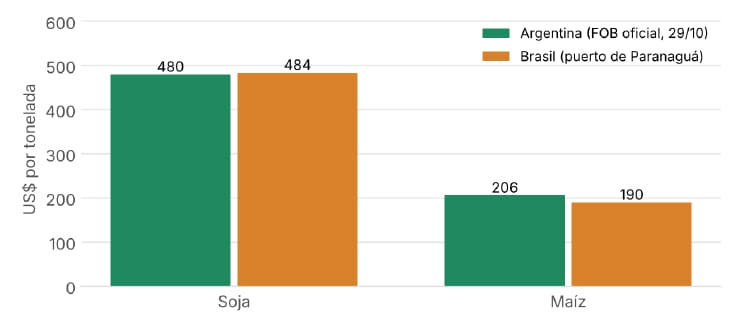
Argentina, official FOB price from the Ministry of Agriculture for Oct 29 (soybeans US$480 and corn US$206). Brazil, soybeans per the Cepea indicator at Paranaguá for Oct 29 (R$158.28 per 60-kilo bag) and corn per AgRural (R$62, latest available figure, from Oct 26), converted at 5.446 reais per dollar. Wheat and sunflower cannot be compared because Brazil does not export them. Argentine FOB wheat stands at US$239, and in Paraná, Brazil, it was fetching about US$288 per tonne on Oct 27 (R$1,569.61), which makes Brazil a natural buyer. Argentine sunflower is quoted at US$606.
In soybeans, Argentina sits about US$4 below the Brazilian price, a minimal gap that shifts with every move in the real. In corn, the Argentine price is about US$16 higher. In wheat, as we noted in the previous edition, Brazil is harvesting about 5.7 million tonnes, the smallest crop since 2020 according to Conab, and will have to buy abroad, while Argentina projects 23.8 million, the second largest in 17 years.
Beef
To compare beef we use the average export price per kilo, which is the figure all three countries publish officially and on the same basis. The dates in the chart differ because the three countries do not report at the same frequency and there is no common cutoff.
Chart 2. Beef exports, average price (US$ per kilo)
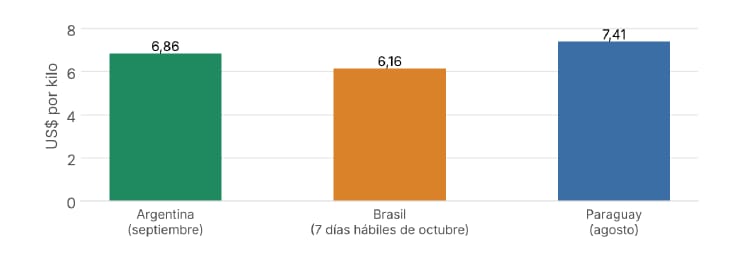
Argentina, Consorcio ABC, September 2026. Paraguay, Senacsa, August 2026. Brazil, Secex, first seven business days of October.
Paraguay and Argentina remain above Brazil. The Brazilian price rose 11.3% from October 2025, but daily export volume fell 39.9%, because China has charged a 55% tariff on Brazilian beef since the annual quota ran out. With a weak real, Brazil can cut prices in the markets where we compete.
Processing potatoes
Here we compare only processing potatoes, the ones that go into frozen French fries. The price of fresh-market potatoes follows a different logic and is not a useful reference.
The northern hemisphere went from surplus to shortage in a few months. In April, surplus potatoes in Belgium were fetching zero euros. As we noted in the previous edition, growers in Belgium, the Netherlands, France and Germany expect to harvest 20.7 million tonnes, 25.4% less than last year, and the United States is expected to have its smallest crop since 2010. In the CMB quotes for Oct 27, Fontane traded between €200 and €225 per tonne in Belgium, with almost no deals because few uncontracted lots are available.
The contract is the price the industry agrees with the grower before planting. The free market is where potatoes left outside contracts are traded, and it shows a surplus or shortage sooner than the contract does. Today the European free-market price is almost double the contract price.
Table 1. Processing potatoes, international benchmarks
| Benchmark | Price | Date | Source |
|---|---|---|---|
| Europe, 2026 contracts | €125 per tonne | July | NEPG |
| Belgium, Fontane free market | €212.50 per tonne | Oct 27 | CMB (Viaverda, Fiwap) |
| France, Fontane free market | €210 per tonne | Oct 27 | CMB (RNM) |
| France, Innovator free market | €230 per tonne | Oct 27 | CMB (RNM) |
| Europe, Fontane free market (used in the ILA) | €220 per tonne | Oct 15 | CMB |
| US, average price for processing potatoes | US$243 per tonne | 2024/25 | USDA ERS |
Fontane, Challenger and Innovator are varieties used for French fries. The Oct 27 quotes come from different markets than the Oct 15 series, so we do not mix them into the index. In the United States each processor keeps its contracts private, and the USDA figure averages all potatoes for processing. In Argentina and Brazil, processors do not publish contract prices either. European 2026 contracts were signed 15% to 25% below 2025 levels.
Since processors in Argentina do not publish contract prices, we compare on cost. We take US$11,686 per hectare for southeastern Buenos Aires province and US$12,136 for Mendoza, and calculate the cost per tonne by yield. The yields are calculation scenarios, not estimates for this season.
Table 2. Cost per tonne of processing potatoes by yield (US$/t)
| Zone | 45 t/ha | 50 t/ha | 55 t/ha | 60 t/ha |
|---|---|---|---|---|
| Southeastern Buenos Aires | 260 | 234 | 212 | 195 |
| Mendoza | 270 | 243 | 221 | 202 |
With yields of 50 tonnes or more, the Argentine cost per tonne is in line with or below the average price US growers receive. With a shortage in the north, growers here should be able to secure better 2027 contracts. Working against this, according to Argenpapa, about 80% of what the Argentine industry produces goes to Brazil, and with a weaker real our product costs Brazilian buyers more.
What it costs to plant in Argentina and Brazil
Chart 3. Cost of planting one hectare (US$/ha)
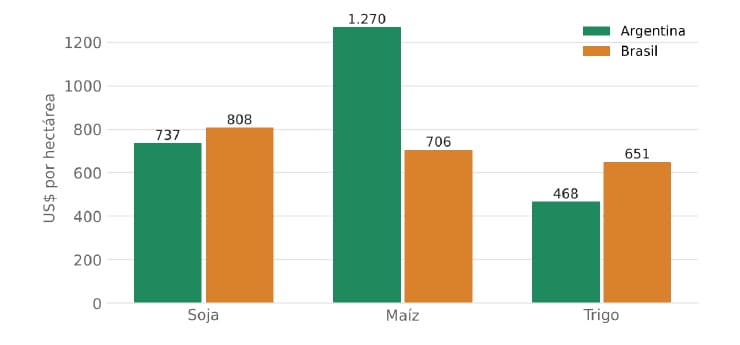
No new data since the previous edition. Argentina, Bolsa de Comercio de Rosario (Rosario Board of Trade) for soybeans and corn in the core farming zone (September 2026) and INTA for wheat (average across zones, June 2026). Brazil, IMEA for soybeans and corn in Mato Grosso (October and September 2026) and Deral for wheat in Paraná (January 2026), converted at 5.35 reais per dollar. At the current rate of 5.446 reais per dollar, the Brazilian values in dollars would be somewhat lower. Mato Grosso corn is second-crop corn, with less fertilizer than Argentina's early-planted corn. Brazil has no significant sunflower production, and for processing potatoes there is no current, public Brazilian cost figure.
Planting soybeans in Brazil is still somewhat more expensive than here, but growers there pay no export duties, while in Argentina soybeans are taxed at 24%, a rate that starts coming down in January until it reaches 21% at the end of 2027.
Weather, wars and the economy
El Niño. The warming of the Pacific, which in the Pampas region usually brings more rain. The latest forecast we were able to verify from the US agency NOAA, dated September 10, put the probability that it will be the strongest since 1950 at 75%, with a peak between October and December. That is good news for yields in the core farming zone, but in southeastern Buenos Aires province the risk is excess water and disease in potatoes.
Iran and oil. The war has gone on for more than eight months with no deal. Brent rose 2.4% on Friday to US$117.64 and gained almost 15% in October. That pushes up diesel and fertilizer, which weigh on almost every field operation.
Black Sea. Russia is the largest wheat exporter. Its return to shipping from Azov, along with the possible talks in November, adds supply and pushes down the price of Argentine wheat.
Federal Reserve. On Wednesday the 28th, the US central bank held its rate in the 3.75% to 4% range, with ten votes in favor and two against, as the two dissenters wanted a 25 basis point hike. Traders are now betting on a hike in December. With high rates the dollar strengthens and grains tend to fall.
Political calendar. The United States holds its midterm elections on Tuesday, November 3, with the war and energy at the center of the debate. In Argentina, bond buyers are already looking ahead to the 2027 elections.
Outlook for the end of the crop season
The map shows the assessment of each activity in the zone where we analyze it. It works as a traffic light that we update in every edition. Green means a favorable outlook, yellow at risk, orange unfavorable and red a critical situation. No assessments changed this week.
Map 1. Outlook traffic light by activity and zone
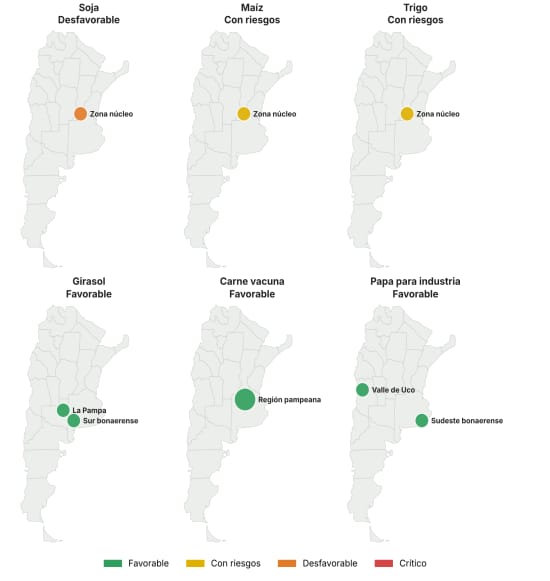
The markers show the zone analyzed, not the exact boundary of each production region. Base map with provincial boundaries.
Table 3. Outlook traffic light by sector
| Sector | Expected production | Outlook | Why |
|---|---|---|---|
| Soybeans | 47.8 Mt (BCR), down 7% | Unfavorable | Chicago falling, Brazil cheaper and 24% export duties |
| Corn | 66.6 Mt (BCBA), up 3% | At risk | El Niño helps yields, but prices are weak and investment per hectare is high |
| Wheat | 23.8 Mt (BCR), second best in 17 years | At risk | Brazil needs to import, but Russia has resumed shipments from Azov and the Black Sea is pulling prices down |
| Sunflower | About 7 Mt (BCBA), 3.1 million ha planted | Favorable | Good export price, low costs and one of the lowest export duties in farming |
| Beef | Exports on track to exceed US$3 billion | Favorable | High prices, although Brazil can compete with lower prices |
| Processing potatoes | Global supply falling | Favorable | Shortage in the north, with risks from excess rain and the weak real |
Mt stands for million tonnes. BCR is the Bolsa de Comercio de Rosario and BCBA the Bolsa de Cereales de Buenos Aires (Buenos Aires Grains Exchange). There was no new data on expected production since the previous edition.
Landkraft Agro Index
The Landkraft Agro Index (ILA) sums up in a single number how the prices that matter most to our sector are moving. It combines ten prices for grains, beef and processing potatoes. Each price is compared with its value at the close on Tuesday, October 27, which we take as the starting point equal to 100, and is weighted by its importance. If it reads 104, the basket is up 4% and sellers are getting paid more. If it reads 96, it is down 4%. Using prices from Friday the 30th, the ILA stands at 99.29, down 0.71% from the base. Grains are down 0.39%, with soybeans, corn and wheat lower and sunflower higher. Beef is down 2.24% on new data from Argentina and Brazil. Potatoes had no new data and remain at 100.
Table 4. ILA composition (base 100 = Oct 27, 2026)
| Component price | Unit | Base value Oct 27 | Value at Oct 30 | Weight | Sector |
|---|---|---|---|---|---|
| Chicago soybeans | US$/t | 451.7 | 449.11 | 15% | Grains |
| Chicago corn | US$/t | 176.7 | 176.27 | 10% | Grains |
| Chicago wheat | US$/t | 224.2 | 221.75 | 7.5% | Grains |
| Argentina FOB sunflower | US$/t | 603 | 606 | 7.5% | Grains |
| Argentina beef exports | US$/kg | 7.11 | 6.86 | 12.5% | Beef |
| Brazil beef exports | US$/kg | 6.28 | 6.16 | 6.25% | Beef |
| Paraguay beef exports | US$/kg | 7.41 | 7.41 | 6.25% | Beef |
| Europe processing potatoes, free market | €/t | 220 | 220 | 20% | Processing potatoes |
| US potatoes for processing | US$/t | 243 | 243 | 10% | Processing potatoes |
| Europe processing potatoes, contract | €/t | 125 | 125 | 5% | Processing potatoes |
Table 5. ILA at the close on Friday, Oct 30, total and by sector
| Index | Weight in total | Value Oct 30 | Change vs. base |
|---|---|---|---|
| Grains | 40% | 99.61 | down 0.39% |
| Beef | 25% | 97.76 | down 2.24% |
| Processing potatoes | 35% | 100.00 | no new data |
| Total ILA | 100% | 99.29 | down 0.71% |
Prices published once a season or once a month, such as the US price, the European contract and Paraguayan beef, are held constant until the new figure comes out. Brazilian beef, first seven business days of October.
Risk Thermometer
The Thermometer measures how much threat there is today, from outside the farm, to Argentine growers' income over the coming weeks. It counts how many things could go wrong because of factors the grower does not control, such as weather, politics or the exchange rate. Whether the business pays off is shown by the traffic light and the ILA. There are five factors. Each receives 0 to 20 points based on the week's information, and the total ranges from 0 to 100. More points means more risk.
Chart 4. Landkraft Risk Thermometer
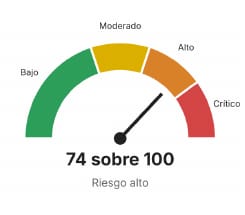
Chart 5. Score by factor
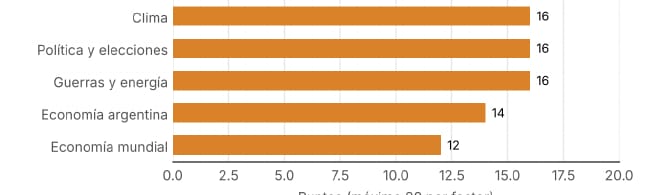
Weather, 16 points. Good soil moisture, but with a risk of excess water in southeastern Buenos Aires province. Politics and elections, 16. Markets in the region are still reeling from the result in Brazil, and the United States votes on November 3. Wars and energy, 16. Brent near US$118 because of Iran, and an unstable Black Sea. Argentine economy, 14. Country risk at 790 and a sharp drop in stocks and bonds. Global economy, 12. A possible rate hike in the United States and selling in tech stocks.
At 74 points we are at high risk. Up to 40 we consider low, 41 to 60 moderate, 61 to 80 high and above 80 critical. The score for each factor did not change from the previous edition.
What to watch next week
First is the result of the US midterm elections on Tuesday, November 3, and how it hits the dollar and oil. Then, whether the real stabilizes and which economic team Lula announces. In wheat, watch the Black Sea, which moves the market more than anything else. In processing potatoes, harvest data from Europe and the United States will weigh on the negotiation of 2027 contracts. The next edition, ACP02, comes out on Saturday, November 7.
Sources
- Bolsa de Comercio de Rosario and Bolsa de Cereales de Buenos Aires, estimates, 2026/27 costs and Chicago closing prices
- Argentina's Ministry of Agriculture, official FOB prices for Oct 29, 2026 and export duties
- Cepea/Esalq and AgRural, prices at Paranaguá
- Consorcio ABC, Secex and Senacsa, beef exports
- USDA (AMS, ERS and NASS), US potato market
- CMB and NEPG, European potato market, quotes for Oct 27, 2026
- Argenpapa, potatoes in southeastern Buenos Aires province
- IMEA, Deral and Conab, costs and harvests in Brazil
- INTA, 2026/27 margins for wheat and summer crops
- NOAA and Servicio Meteorológico Nacional, El Niño forecast
- Infobae, Agência Brasil, Ruralnet, Cronista and Bloomberg Línea, markets, the Fed, oil and politics